
Tooth Decay in Children: Signs, Causes and Treatment

Not long ago, a mother at our clinic told me that her 5-year-old daughter no longer wanted to drink even her favorite chocolate milk. During the exam, we found two baby teeth with advanced decay. "I always made her brush, so how did this happen?" she asked, and then: "I wish I'd noticed sooner." That's why I wrote this article.
Early childhood caries (tooth decay in young children) affects almost half of preschool children worldwide, according to a 2021 global review in the International Journal of Paediatric Dentistry. As parents, you want your child to grow up healthy, happy and confident. But in the rush of daily life, decay in children can easily go unnoticed early on. Even a cavity that looks minor can make eating harder, disturb sleep and affect your child's quality of life.
In this article, I explain how tooth decay develops in children, how to spot its early signs and, most importantly, practical steps you can start today to protect your child's teeth.
In this article:
What is tooth decay in children, and how does it develop?
Causes: why are some children at higher risk?
How to spot the early signs
How tooth decay in children is treated
How to prevent tooth decay
A prevention guide by age
Frequently asked questions
Let's look at the details.
What Is Tooth Decay in Children?
Tooth decay starts with the activity of bacteria in the mouth. These bacteria live naturally in everyone's mouth and produce acid as they break down the sugars and carbohydrates we eat. Over time, these acids damage the mineral structure of enamel, the tooth's hard outer layer. Enamel is one of the hardest tissues in the body, but it can't hold out against repeated acid attacks. Normally, saliva neutralizes the acids and starts remineralization, which restores lost minerals. When sugar is eaten often and oral hygiene falls short, this natural repair can't keep up, and decay begins. In baby teeth the process moves faster, because their structure is more delicate and less resistant to bacterial acids. That's why early decay in baby teeth is, unfortunately, something we see very often.
Baby teeth are often dismissed with "they'll fall out anyway". But as well as supporting eating and speech, baby teeth guide the permanent teeth into place. Decay in a baby tooth can affect the permanent tooth developing underneath, and losing a baby tooth early can cause problems with jaw development. That's why early treatment matters for a child with decay.

What Causes Tooth Decay in Children?
There's usually more than one reason. Your child's tooth structure, daily eating habits, brushing routine and genetics all play a part. Let's look at the most common causes:
1. Sugary food and drinks
Children are naturally drawn to sweet tastes. Sugary snacks, fizzy drinks, fruit juice and sweetened dairy products feed the bacteria in the mouth, which produce acids that damage enamel as they break down sugar. Sticky sweets stay on the teeth longer and raise the risk further. Sugary food and drinks before bed are the biggest danger, because saliva flow drops during sleep and the teeth are left unprotected.
2. Not enough brushing
Most children don't find brushing fun. Rushed mornings and sleepy evenings mean teeth often don't get the care they need, and plaque builds up, creating ideal conditions for decay. Brushing with the wrong technique is a problem too. Young children's motor skills are still developing, so they need a parent's help. Until age 7–8, check your child's brushing or do the final once-over yourself.
3. The delicate structure of baby teeth
The enamel of baby teeth is thinner and less mineralized than that of permanent teeth, which makes them more vulnerable to decay.
4. Bottle decay and feeding habits
Early tooth decay in babies is often called baby bottle tooth decay. It's common in babies who drink milk, formula or juice from a bottle through the night or while falling asleep. When sugary liquids stay on the teeth for a long time, decay starts quickly, especially around the front teeth. Bottle decay is one of the most severe forms of early decay and can appear in babies as young as 18–24 months. It progresses fast and can affect several teeth at once.
5. Genetic and family factors
Some children are born with softer enamel. A family's oral care habits and eating patterns also affect a child's risk of decay.
What Are the Signs of Tooth Decay in Children?
Tooth decay in children, especially early decay, can go unnoticed. Young children can't always put pain into words, so parents often notice changes in behavior first. If your baby or child often holds their mouth, avoids eating, or loses interest even in favorite foods, don't dismiss it as "just a phase". This is exactly how early decay in babies can show itself.
Signs to look out for:
1. Pain and sensitivity
Watch for aching or sudden pain after cold, hot, sweet or sour food, discomfort while chewing, waking at night with toothache, or restless sleep. A child who often touches a tooth or chews on one side only may also have a problem with their teeth.
2. Visible changes
Many parents think decay starts with a black hole or severe pain. In fact, the earliest sign, and one that is still reversible, is dull white spots or lines near the gum line.

These show that the enamel has started to lose minerals (demineralization). This stage is our "golden opportunity". If the white spots are caught early and treated with professional fluoride applications and better oral hygiene, the enamel can repair itself and the decay can be stopped. Once the spots turn yellow, brown or black, though, the decay has spread into the tooth and the hard tissue has weakened. As decay progresses, the spots darken and become more visible, and eventually holes appear in the tooth.
3. Changes in behavior
Babies and young children can't always tell you they're in pain, so small changes in behavior matter. Reluctance to eat, avoiding certain foods, being more restless or irritable than usual, or suddenly resisting brushing can all point to pain. Sleep problems, crying at night, or holding and rubbing one cheek can also suggest a problem with the teeth.
4. Other physical signs
Bad breath: persistent bad breath despite regular brushing can be a sign of decay or infection.
Gum problems: swelling, redness or bleeding around the decayed tooth
Abscess: with advanced decay, a swelling or pus-filled pocket can form on the gum or cheek
How Is Tooth Decay in Children Treated?
Many parents who come to our clinic are worried about their child's treatment: "Will it hurt?" "Will my child be scared?" Modern pediatric dentistry has made treatment more comfortable and child-friendly.
The treatment depends on the size and location of the decay and the child's age. Very early decay can be stopped with professional fluoride applications. Fluoride gel or varnish strengthens the enamel surface and can stop decay from progressing. Another option is fissure sealants. The deep grooves on the back teeth are ideal hiding places for food and bacteria. Sealants cover these grooves with a thin protective layer that helps prevent decay. Placing them involves no drilling and no anesthetic, and they significantly lower the risk of decay at a young age.
Fillings are the most common treatment for small and medium-sized cavities. First, the tooth is numbed with a local anesthetic to keep discomfort to a minimum. Then the decayed tissue is removed and the cavity is filled, shaped and polished. Composite fillings are tooth-colored, so they look natural. A filling stops the decay from progressing and restores the tooth's function.
If decay has reached the nerve tissue inside the tooth (the pulp), root canal treatment may be needed. Some parents are surprised: "A root canal on a baby tooth?" But it's often the way to save the tooth. Losing baby teeth early can make permanent teeth come in crooked, so we try to keep baby teeth in the mouth for as long as possible. After root canal treatment, a stainless steel crown or a zirconia crown is usually placed on the tooth. Stainless steel crowns are used on baby teeth with large cavities or after root canal treatment. Crowns cover the whole tooth, are durable, and usually protect the baby tooth until it falls out.
As pediatric dentists, we recommend extraction only as a last resort. But if the decay is very advanced and the tooth can't be saved, it may need to come out. If a baby tooth is lost early, space maintainer appliances help the permanent tooth come in in the right position. They stop the neighboring teeth from drifting into the gap and keep room for the permanent tooth.
For very young children, or when several teeth need treatment, everything can be done in one session, with the child comfortable, under general anesthesia at a partner hospital, where an anesthesiologist manages the anesthesia. The pediatric dentist makes this decision based on the child's age, cooperation and treatment needs.
How to Prevent Tooth Decay in Children
"Prevention is better than cure" holds especially true for tooth decay in children. Small but consistent habits can protect your child's oral health in the long run.
1. Brush correctly and regularly
We recommend brushing your child's teeth regularly from the moment the first tooth appears.
How often? At least twice a day, after breakfast and before bed, for 2 minutes each time.
Technique matters too: your child should brush in small circles, from the gums toward the tips of the teeth. We recommend a parent checks or helps until age 7–8.
2. Use dental floss
Floss is essential for cleaning between the teeth. Once your child's teeth start touching (usually around age 2–3), you can start flossing once a day. Do it for them at first; over time your child will learn how.
3. Manage sugary food and drinks
Managing sugar sensibly works better than banning it outright. For example, keep sugary snacks to mealtimes, and if you give juice, dilute it and serve it only with meals. Most importantly, no sugar before bed.
4. Manage bottle and pacifier habits
Bottle use needs care when it comes to your child's teeth. Give the bottle only at feeding times and don't let it become a sleep companion. It should contain only milk, formula or water; never add sweeteners such as honey, sugar or syrup. Encouraging the move from bottle to cup at around 12–18 months, and aiming to stop the pacifier after age 2, supports healthy tooth development.
5. Regular dental check-ups
The American Academy of Pediatric Dentistry (AAPD) recommends a first visit to a pediatric dentist within six months of the first tooth appearing, and no later than the first birthday. After that, check-ups every 6 months are usually recommended.
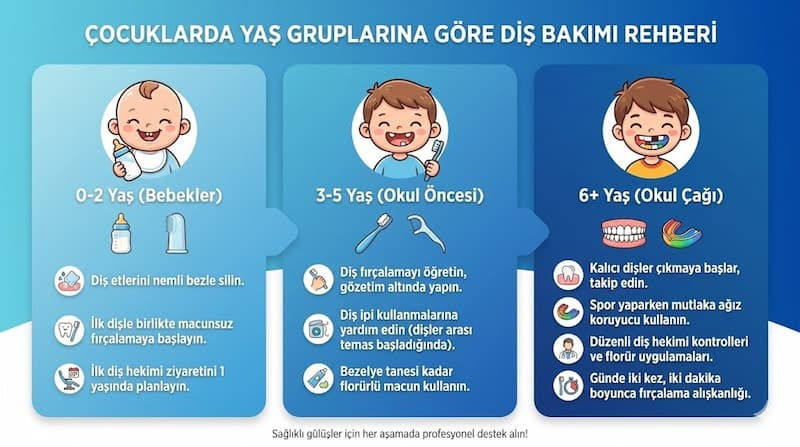
6. A care guide by age
Each age group has its own needs and risks. Here's how to protect your child's teeth at each age:
Ages 0–2: preventing tooth decay in babies
This is when the foundations of oral health habits are laid. Once the first tooth appears, start cleaning it twice a day with a soft baby toothbrush or a clean piece of gauze.
Night feeds need special attention. Once teeth have come in, avoid putting your baby to sleep with a bottle. If you breastfeed at night, wipe the teeth with a clean cloth afterwards when you can. The bottle should never contain sugar, honey or juice; use only water, breast milk or formula.
Another key point at this age is preventing the spread of bacteria. Avoid putting your baby's spoon in your own mouth, licking the pacifier, or sharing a spoon with your baby. Decay-causing bacteria pass easily from mouth to mouth this way.
The first dental visit is best made after the first tooth appears, and by the first birthday at the latest. As well as catching problems early, this visit is a chance to learn the right care techniques.
These steps help lower the risk of early decay in babies and give your child's teeth a healthy start.
Ages 3–5: protection in the preschool years
Your child becomes more independent at this age but still needs your help with brushing. Even if they brush on their own, always do a final check. Snacks matter more now: once your child starts nursery or preschool, they meet new foods. Offer healthy snacks at home to build good habits.
The gaps between teeth start to close at this age, so it's time to start flossing. Do it for them at first, then teach them over time. Keep up check-ups every 6 months. Depending on your child's needs, your dentist may recommend fissure sealants.
Age 6+: what to watch in the school years
The biggest risks for school-age children are growing independence and outside influences. The newly erupted permanent molars (the "six-year molars") are very prone to decay, and we recommend sealing them.
Your child may brush on their own now, but regular checks and help when needed still matter until age 7–8. Check especially after the evening brush. Most children can learn to floss at this age; be patient and help them practice regularly.
Help your child understand the new foods and drinks they'll meet at school. Talk about acidic drinks, frequent sugary snacks and sticky sweets, and encourage healthy choices at the school canteen.
Children who take up sports or physical activities should wear a mouthguard. Check-ups should continue every 6 months, and an orthodontic assessment becomes important at this age.
Take Action for Your Child's Healthy Smile
Healthy teeth and a bright smile are largely in your hands. Good habits started early lay the foundation for healthy teeth for life. If you notice any change, spot, pain or sign of decay in your child's teeth, it's important not to wait.
At KidsDent Istanbul, our pediatric dentist cares for children's teeth in a child-friendly setting, with an approach adapted to each child's age.
For questions, concerns or appointments, give us a call.

Frequently Asked Questions About Tooth Decay in Children
1. When does tooth decay start in babies?
Tooth decay in babies can start as soon as the first baby tooth comes in (usually around 6–12 months). The most common form is baby bottle tooth decay. That's why oral hygiene should start with the first tooth, with special attention to night feeds.
2. Baby teeth fall out anyway. Does decay really need treatment?
Yes. Untreated decay in baby teeth can turn into a serious infection and damage the permanent tooth developing underneath. Losing baby teeth early can also make permanent teeth come in crooked or out of line, which can affect your child's smile, confidence and even speech development. Early treatment helps protect both your child's comfort today and their healthy smile tomorrow. So don't let "it's only a baby tooth" be a reason to leave decay untreated.
3. My child has white spots on their teeth. Is it decay?
White spots can be the earliest stage of decay. Known as enamel demineralization, this stage can be reversed if treated early: your dentist can treat the spots with fluoride and help you improve oral hygiene. In some cases, white spots can also be a sign of fluorosis (too much fluoride). For a definite diagnosis, see a pediatric dentist.
4. Is treating tooth decay painful for children?
Local anesthetic numbs the area, so most children feel pressure rather than pain during treatment. For very young or very anxious children, treatment under general anesthesia at a partner hospital may be considered.
5. My child has toothache. What can I do at home?
For temporary relief until you can see a dentist:
A cold compress on the cheek on the painful side can reduce gum swelling.
If your child is old enough to rinse and spit, have them rinse with warm salt water (1 glass of warm water + 1 teaspoon of salt).
While the pain lasts, have your child avoid hard, hot or very cold foods.
Toothache can be a sign of infection, so remember these are only temporary measures. We recommend having your child seen by a pediatric dentist as soon as possible.
6. Is tooth decay at age 2 normal?
Unfortunately, decay at age 2 is more common than you might think, but it should never be considered "normal". Baby teeth start coming in at around 6 months, so by age 2 a child's teeth have been in the mouth for about 18 months, which is long enough for decay to develop.
As a pediatric dentist at our clinic in Istanbul, I care for children's oral health. Contact the clinic with any questions or to book an appointment.


